
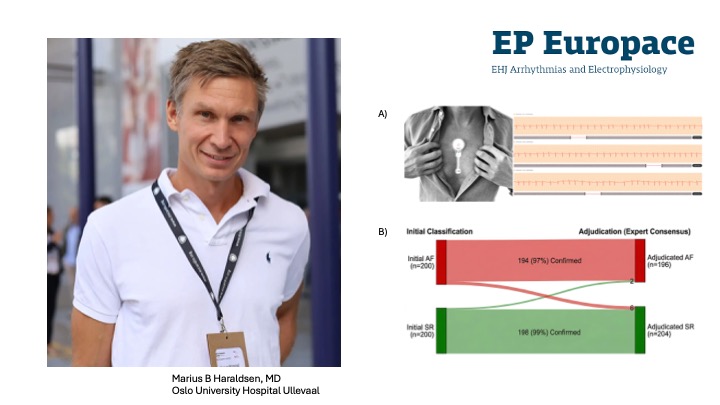
A new study published in EP Europace demonstrates that ECG247 provides a high level of agreement in the diagnosis of atrial fibrillation. For clinicians, the findings from the NORSCREEN trial signify not only increased diagnostic certainty but also the potential for a more resource-efficient workflow. The NORSCREEN trial is a nationwide Norwegian atrial fibrillation screening study encompassing more than 50,000 participants.
For arrhythmia evaluation, it is crucial to utilize tools that are both precise and time-saving. This new study shows that ECG247 achieves high consensus among cardiologists evaluating ECG recordings.
Diagnostic Certainty
The study investigated interrater agreement by having independent cardiologists evaluate 400 ECG recordings. The results demonstrated:
-
97% agreement in identifying atrial fibrillation.
-
99% agreement in excluding atrial fibrillation.
This high level of agreement confirms that classification based on ECG247 is highly reproducible.
Streamlining Clinical Workflow
A key implication of these results is their potential to free up valuable healthcare resources. The study highlights that the high level of consensus makes routine dual interpretation unnecessary.
By implementing ECG247, physicians and hospitals can achieve several significant advantages:
-
Targeted use of expertise: Comprehensive manual review by experienced cardiologists can be reserved strictly for equivocal cases.
-
Enhanced diagnostics: Because ECG247 provides continuous monitoring over time, arrhythmias are captured much more effectively than with intermittent measurements, thereby reducing the need for follow-up investigations.
-
Robust decision-making data: The ability to differentiate atrial fibrillation from its «mimics» (such as frequent premature contractions or SVT runs) directly within the recording provides physicians with a highly precise foundation for clinical decisions.
A Strong Alternative to Spot Checks
The study discusses the critical need for diagnostic reliability in screening, particularly for asymptomatic individuals. While other trials, such as the SAFER study, have reported only moderate reliability when using intermittent, handheld devices (thumb ECGs), the NORSCREEN findings demonstrate that a continuous patch ECG is exceptionally well-suited for establishing definitive diagnoses. By choosing a method with high diagnostic precision, clinics can eliminate diagnostic uncertainty—saving time, reducing patient anxiety, and preventing unnecessary follow-up examinations.
The study confirms that ECG247 is a clinically safe and reliable method that can contribute to a much more efficient diagnostic process.
The study «Interrater agreement in atrial fibrillation diagnosis using one-week single-lead patch ECG monitoring: Findings from the NORSCREEN trial» is published in EP Europace.