
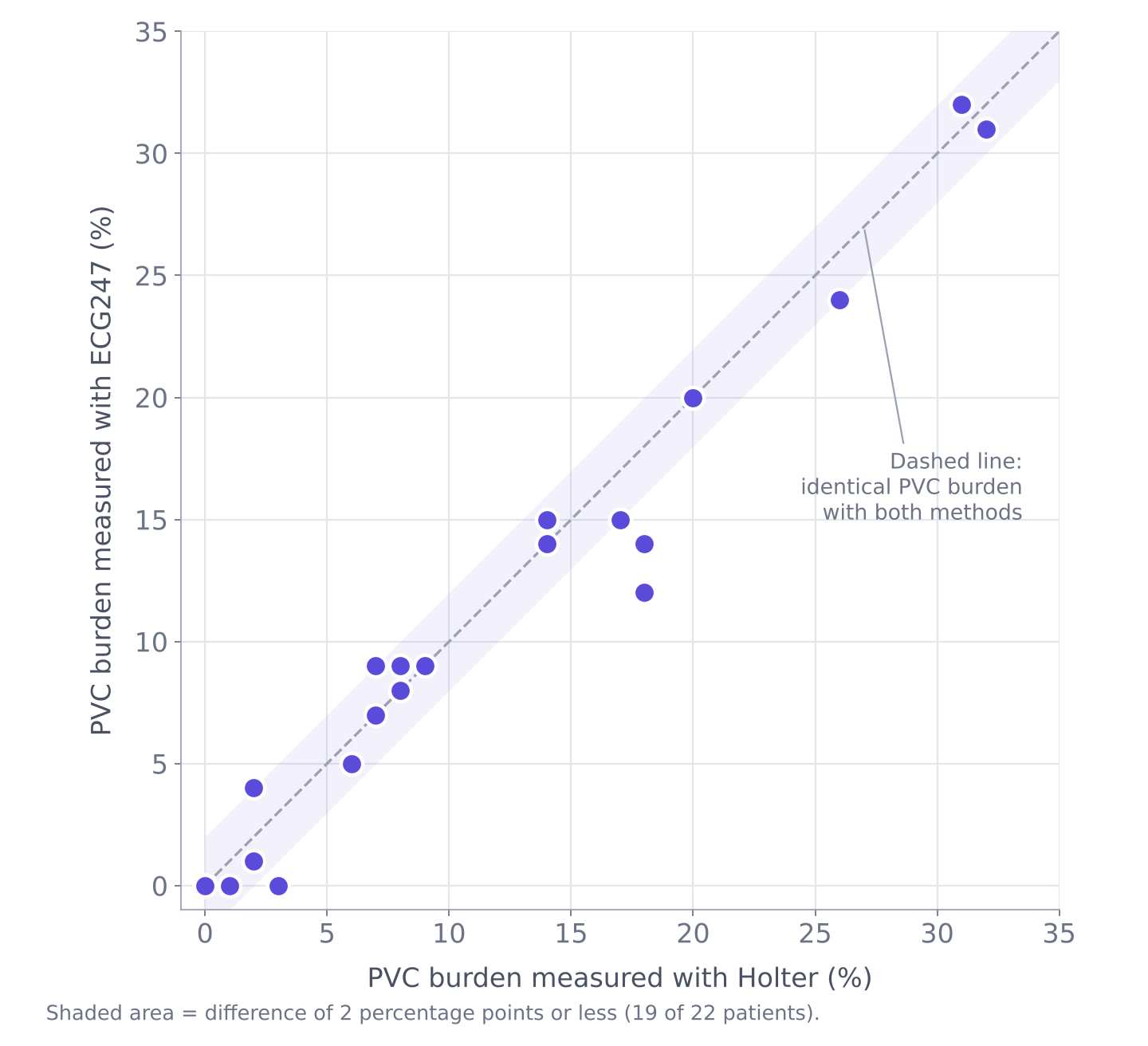
A new comparison shows that ECG247 gives almost the same PVC burden as Holter monitoring. The new beat morphology grouping feature makes this possible.
Premature ventricular contractions (PVCs) are among the most common findings in long-term ECG monitoring. The proportion of heartbeats that are PVCs, known as the PVC burden, is clinically important. A high PVC burden, often defined as 10% or more, can weaken the heart’s pumping function over time and affects further investigation and treatment.
Same patients, two methods
To test how well ECG247 measures PVC burden, we carried out a comparison. Patients wore ECG247 and a traditional Holter monitor at the same time.
With ECG247’s new beat morphology grouping feature, the results were very similar:
- The average difference in PVC burden between ECG247 and Holter was less than 1 percentage point.
- In 19 of 22 patients, the difference was 2 percentage points or less.
- All 9 patients with a high PVC burden (10% or more) on Holter also had a high PVC burden on ECG247.
- Agreement between the methods was very high, with a correlation of 0.98.
Beat morphology enables precise counting
The new feature automatically groups similar heartbeats. The user can then quickly review and confirm each group. This makes it easy to tell PVCs apart from normal beats and makes PVC counting more precise. Without the grouping, the PVC burden was often lower than on Holter, especially in patients with many PVCs.
Easier for the patient, equally useful for the physician
The results show that physicians can use ECG247 to assess PVCs and PVC burden with the same confidence as with traditional Holter monitoring.
The comparison includes 23 long-term ECG recordings with simultaneous Holter and ECG247 monitoring. This is a small study, and the results should be confirmed in larger datasets.