
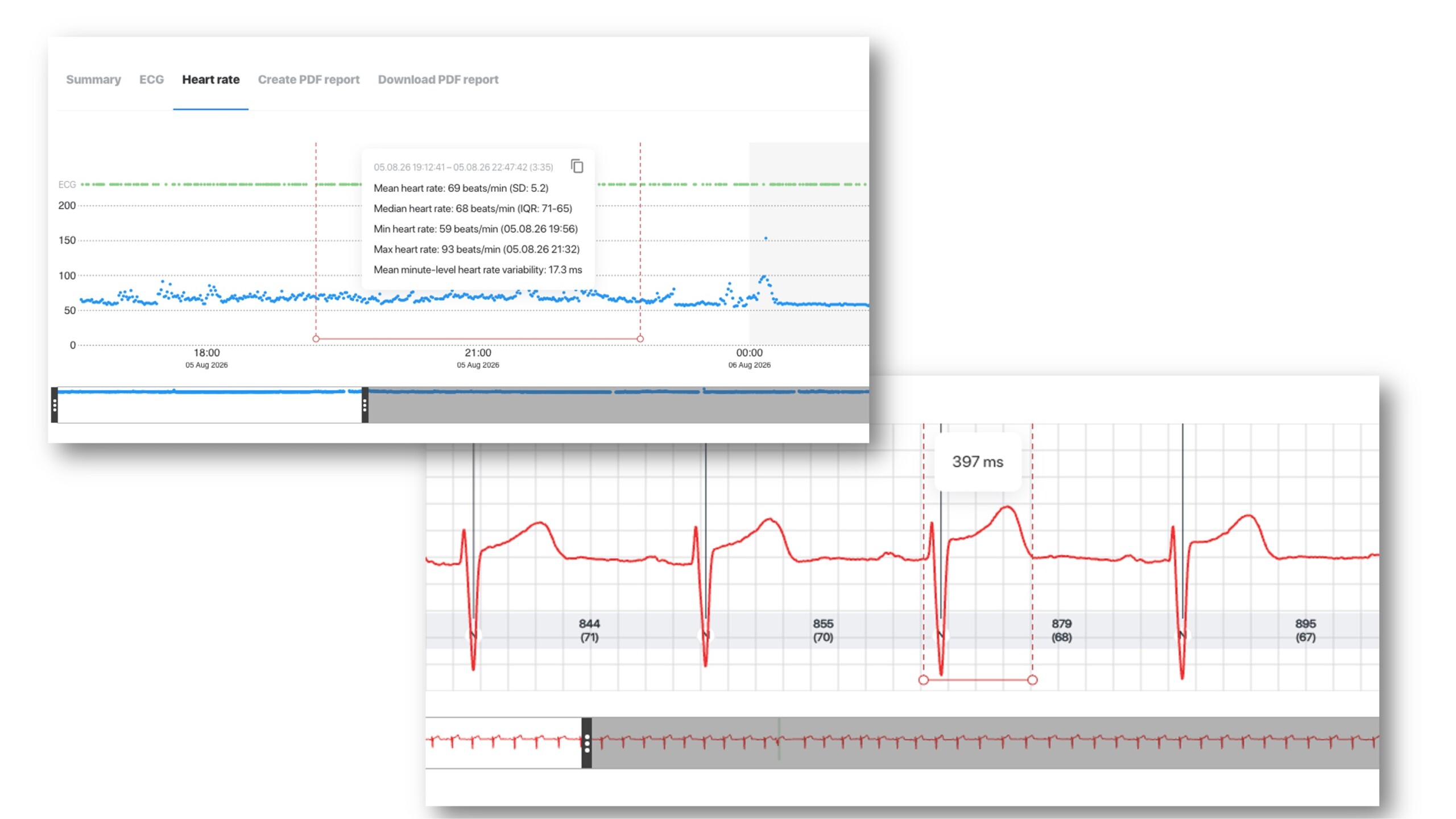
We have updated the ECG247 Portal with new and improved interactive measurement tools, making the analysis of heart rhythm recordings even easier.
What’s new?
- Flexible calculation of heart rate and heart rate variability:
Select any time section in the heart rate graph to view aggregated statistics for that period:
-
-
Average heart rate
-
Median heart rate
-
Minimum and maximum heart rate
-
Heart rate variability at the 1-minute level
-
-
Improved measurements on the ECG tracing:
Updated and enhanced caliper/measurement tool in the ECG strip to measure exact duration in milliseconds (e.g., QRS duration, QT interval, or RR intervals).
Heart Rate Variability (HRV)
Heart rate variability (HRV) measures the natural, minor variations in the time interval between consecutive heartbeats. HRV reflects, to a certain degree, the balance of the autonomic nervous system—the interaction between the body’s «accelerator» (sympathetic) and «brake» (parasympathetic/vagus).
In the ECG247 Portal, HRV is calculated as the average signal variance per minute measured in milliseconds (ms). The measurement is based on 1-minute epochs where technical artifacts and noise are automatically filtered out.
HRV is naturally influenced by age, activity level, posture, and time of day. For an adult at rest or during normal daily activity, the following normal reference ranges for average HRV are commonly used:
| HRV Value | Category | Interpretation |
|---|---|---|
| Low | Monotonous heart rhythm. Typical during physical/mental stress, acute illness, fever, or poor physical fitness. | |
| Normal – acivity | Normal level during typical daily activities or in older individuals at rest. | |
| Normal – rest | Expected level during quiet rest and restful sleep. | |
| High | Typical during deep sleep, in younger individuals, or in well-conditioned individuals. |
Evaluating average HRV over a selected time period provides insight into the patient’s general level of autonomic tone and activation during that timeframe:
-
Changes over time: A distinct drop in average HRV compared to the patient’s own baseline may serve as an early indicator of physiological stress, infection, inadequate recovery, or worsening cardiovascular condition.
-
Diurnal variation: It is entirely normal for average HRV to be lower during the daytime (8–12 ms) due to movement and activity, and higher at night (12–20+ ms) during restful sleep.
Note: Because ECG247 measures continuously throughout the day using 1-minute variance windows, the numbers will naturally be somewhat lower than single nighttime measurements from certain consumer apps (e.g., traditional overnight RMSSD). The key clinical priority is tracking individual changes over time.