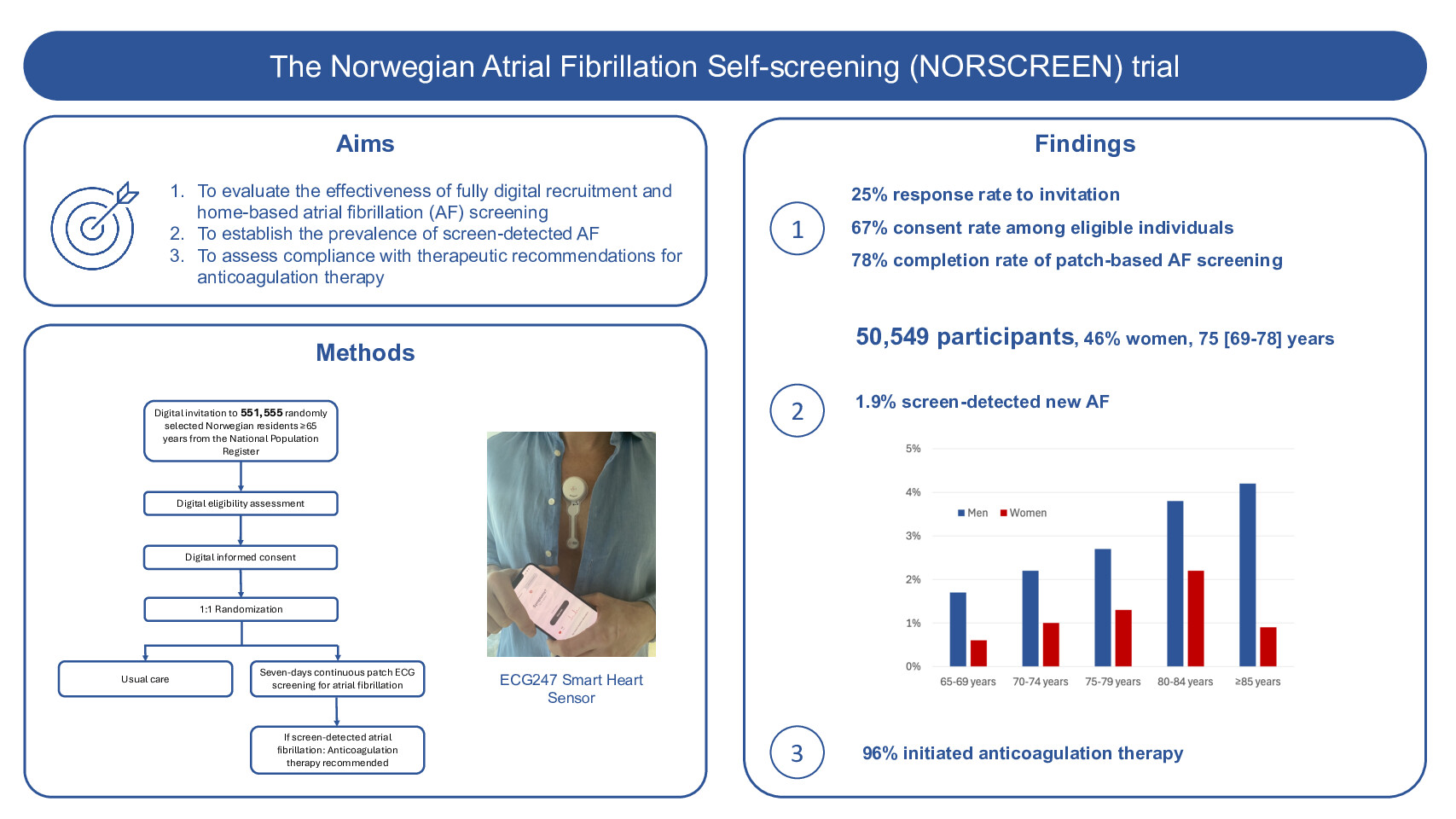
More results from the nationwide NORSCREEN study (50,549 participants) have now been published in the renowned journal Europace. The study concludes that fully digital, site-less screening with ECG247 is a highly effective and scalable method for early detection of atrial fibrillation in the general population.
The large, randomized controlled trial NORSCREEN investigated the utility of fully digital recruitment and continuous at-home ECG monitoring for individuals at increased risk of stroke. The results confirmed that ECG247 provides a high completion rate, identifies undiagnosed atrial fibrillation in 1.9% of those screened, and leads to nearly all patients with detected AF initiating preventive treatment.
Key Figures from the Study:
- 50,549 participants digitally enrolled in the study.
- 78.1% completed the ECG screening in their own homes.
- 1.9% had previously undiagnosed atrial fibrillation detected.
- 95.8% of patients with detected atrial fibrillation initiated preventive treatment with oral anticoagulants.
Digital Precision and Seamless Home Execution
Atrial fibrillation (AF) is the most common heart rhythm disorder and a major cause of stroke. Because the condition often occurs in brief episodes (paroxysmally) or completely without symptoms, it frequently goes undetected. Conventional screening methods often demand substantial resources, physical attendance, and time at hospitals.
In the NORSCREEN study, over 550,000 Norwegians aged 65 or older were invited via digital letters on *Helsenorge*. A total of 50,549 eligible individuals were enrolled and randomized. Participants in the screening group received the ECG247 sensor directly in the mail and conducted continuous ECG monitoring in their own homes for approximately seven days.
«The study demonstrates that a fully digital, site-less approach using ECG247 enables large-scale population screening in an effective and scalable manner.»
— Conclusion from the NORSCREEN study in Europace
Why is ECG247 Ideal for Digital At-Home Screening?
ECG247 combines an ECG patch, a reusable sensor, a dedicated smartphone app, and automated real-time cloud analysis. The system is a CE-marked medical device that enables continuous rhythm monitoring. The sensor is easy to apply by oneself, comfortable to wear during daily activities and sleep, and ensures the automatic transmission of ECG data. This makes the solution optimal for fully digital, site-less healthcare services where patients avoid the burden of hospital visits.
Impact on Future Healthcare Services and Stroke Prevention
The NORSCREEN study confirms that ECG247 is not only a solid technological solution, but a fully clinically feasible model for early detection of heart disease. By combining digital recruitment, postal delivery of sensors, and automated ECG analysis, the healthcare service can reach high-risk groups nationwide without burdening hospital outpatient clinics.
The primary endpoint of the NORSCREEN study — whether screening over time reduces the incidence of stroke — will be available after a five-year follow-up period. However, the recent results in Europace already document that digital at-home screening with ECG247 is an effective strategy.
Reference:
Boskovic M, Haraldsen MB, Berge T, Grenne BL, Skretteberg PT, Engdahl J, Løchen ML, Schuster P, Grimsmo J, Atar D, Anfinsen OG, Pripp AH, Jortveit J, Halvorsen S. Digital recruitment and prevalence of screen-detected atrial fibrillation in nationwide patch-based ECG screening: The NORSCREEN randomized clinical trial. Europace, 2026.